The starting place
The follicle bulge and departing stem cells
I’m drawn to hair growth as a story of cells doing particular things.
Normal rats, mice and whisker-follicle cells
The hair-follicle study examined thymosin beta-4 in normal rats and mice and in rat vibrissa follicle keratinocytes. Vibrissae are whiskers; that term locates the cell work more precisely than a general phrase such as hair cells. The researchers reported stimulated hair growth through activation of bulge stem cells, with increased migration and differentiation. The species and the cell population are useful parts of the finding, rather than formalities to hurry past.
The smallness of the starting place appeals to me. A follicle contains a much more particular research problem than the word regeneration suggests. There is a named population, a reported change in its behaviour and a hair-growth endpoint. That combination is enough to hold a biological argument together without borrowing a human result. The paper’s title names the follicle stem cells, and I’d leave them at the centre of the discussion.
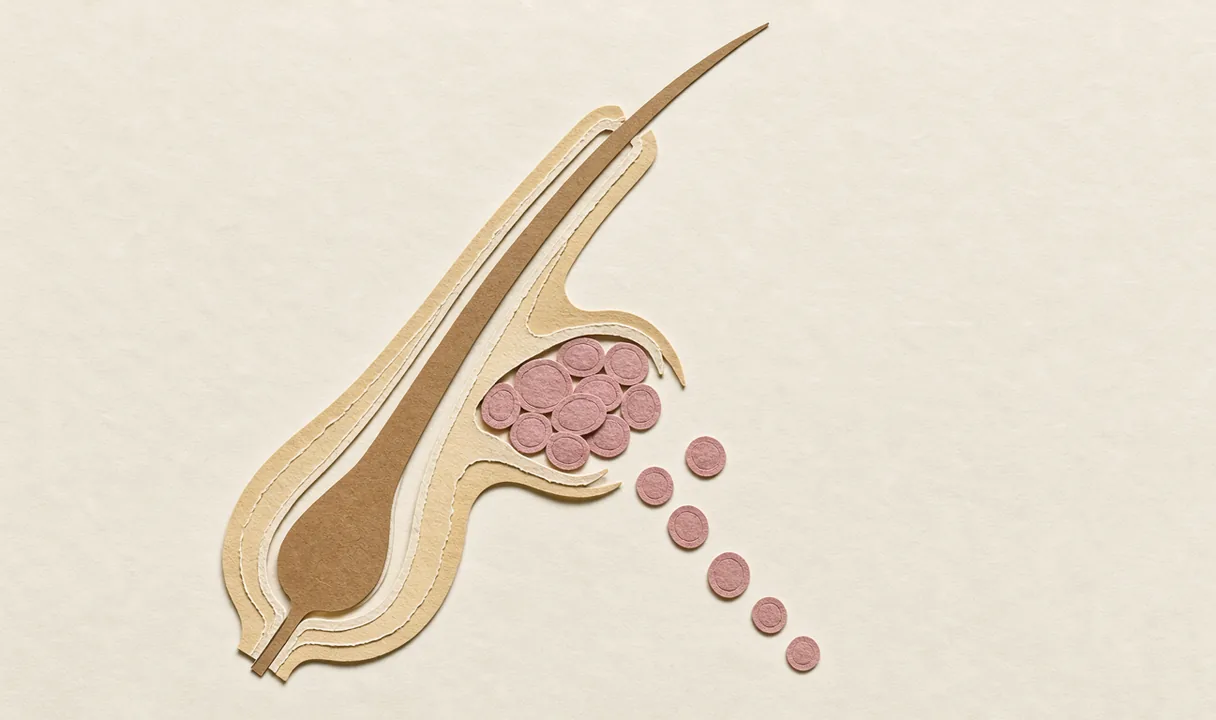
Migration and differentiation
Migration describes a change of place; differentiation concerns a change towards a more specialised cell state. Both increased in the thymosin beta-4 follicle research. Migration and differentiation each deserve room here, although activation is a useful description of the overall result. Movement and a change in cell state give the proposed explanation different work to do.
Their relationship is the interesting puzzle for me. Does movement precede the relevant change in state, or do the activities proceed together under these conditions? Which observation would distinguish those possibilities? The result prompts those questions without supplying their answers. The report of both activities gives the questions a reason to exist. A neat departure metaphor would become misleading if it silently supplied an order the finding never established.
MMP-2 expression
Of the follicle findings, MMP-2 expression is the small surprise for me. The researchers reported an increase alongside enhanced migration and differentiation. Hair growth is the visible endpoint in the account, yet this molecular observation gives the story an inward turn as well: a change in expression accompanies a change in cell behaviour. That is a much livelier picture than the word growth alone summons. The relationship among those activities deserves its own investigation.
The review of thymosin beta-4’s properties places actin binding, mobilisation and stem-cell activities within a broader tissue-repair picture. That breadth is helpful background, although I prefer the follicle result’s concrete setting. A review can connect findings from several models; the follicle experiment gives those connections a local test. The actin-bound structure then offers a separate, molecular-scale question about the material held by the protein.
Hair growth after cellular activity
The tissue endpoint in the rat and mouse work was stimulated hair growth. That outcome gives the cellular activities a consequence worth investigating. The migration story supplies a satisfying puzzle: finding a useful endpoint in this setting still leaves questions about how much each observed activity contributes to it.
The strongest attraction for this connection register is the pairing of cell behaviour with that endpoint. The cells get underway and the study examines a tissue change. The pairing is more informative than either phrase floating on its own, and it remains an animal and cell-culture finding. A careful account of that relationship under those conditions is the kind of follow-up I’d welcome.
The protein studied here was thymosin beta-4. The TB-500 analytical paper defines a synthetic active-region fragment, a distinct experimental subject. Questions about that fragment need their own evidence. The follow-up essay introduces another complication: a mouse muscle experiment in which more regenerating fibres accompanied no significant gain in strength. That is a useful companion to an appealing hair-growth result.